in The Guardian,
Saturday October 25 2008
Original article here
There are nice jokes and naughty jokes, and a new genre of neocon ones - but why exactly do we find them funny? Jim Holt on how philosophers have explained our sense of humour.
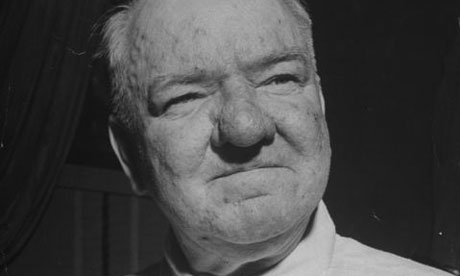
'Do you believe in clubs for small children?' WC Fields was asked. 'Only when kindness fails,' he replied. Photograph: Ralph Crane/Time Life Pictures/Getty
A passage in a Bach fugue may fleetingly give you goosebumps. A line from Yeats might make you tingle a bit, or cause the little hairs on the back of your neck to stand up in appreciation. But there is one kind of aesthetic experience whose outward expression is grossly palpable, involving as it does the contraction of 15 facial muscles and a series of respiratory spasms. Healthful side effects of the experience are believed to include oxygenation of the blood, a reduction in stress hormones and a bolstering of the immune system. But if the experience is too intense, cataplexy can set in, leading to muscular collapse and possible injury. In rare cases the consequences are graver still. Anthony Trollope suffered a stroke undergoing this experience, while reading a now forgotten Victorian novel, Vice Versa. And the ancient Greek painter Zeuxis, reacting to the portrait of a hag he had just made, actually died of it.
What I have been describing is, of course, laughter. It is our characteristic response to the humorous, the comical, the funny. What is it about a humorous situation that evokes this response? Why should a certain kind of cerebral activity issue in such a peculiar behavioural reflex?
While there can be laughter without humour - tickling, embarrassment, nitrous oxide and vengeful exultation have been known to bring it forth - there cannot be humour without laughter. That, at any rate, is what contemporary philosophers think. "The propensity of the state of amusement to issue in laughter is arguably what is essential to its identity," we read under "Humour" in the Routledge Encyclopedia of Philosophy. Laughter is physical. You have to have a body to do it. Mere possession of a body, however, does not guarantee that one will laugh with any frequency. Isaac Newton is reported to have laughed precisely once in his life - when someone asked him what use he saw in Euclid's Elements. Joseph Stalin, too, seems to have been somewhat agelastic (from the Greek a-, "not", gelastes, "laugher"). "Seldom did anyone see Stalin laugh," we read in Marshal Georgy Zhukov's reminiscences. "When he did, it was more like a chuckle, as if to himself." Other reputed agelasts include Jonathan Swift, William Gladstone and Margaret Thatcher.
Like love, its only rival as an inner source of pleasure for mankind, laughter bridges the realms of the mental and the physical: so observed the incomparable Max Beerbohm in his 1920 essay "Laughter". But, Beerbohm noted, whereas love originates in the physical and culminates in the mental, the vector of laughter points in the opposite direction. One might also draw a parallel with sex. The objective in sexual congress, according to the Marquis de Sade, is to elicit involuntary noisemaking from your partner - which is precisely the object of humour, even if the nature of the noisemaking is a bit different.
Nothing in the philosophical tradition has produced a sustained account of humour and laughter that bears comparison with Freud's Jokes and Their Relation to the Unconscious. Freud's interest in the problem of humour was not primarily philosophical. Rather, he was specifically attracted to jokes because of their many likenesses to dreams. In both jokes and dreams, Freud observed, meanings are condensed and displaced, things are represented indirectly or by their opposites, fallacious reasoning trumps logic. Jokes often arise involuntarily, like dreams, and tend to be swiftly forgotten. From these similarities Freud inferred that jokes and dreams share a common origin in the unconscious. Both are essentially means of outwitting our inner "censor". Yet there is a critical difference, Freud insisted. Jokes are meant to be understood; indeed, this is crucial to their success. The meaning of a dream, by contrast, eludes even the dreamer.
Freud was an avid collector of jokes, particularly Jewish jokes, and his book contains 138 specimens, by my count, some of which are excellent. ("A royal personage was making a tour through his provinces and noticed a man in the crowd who bore a striking resemblance to his own exalted person. He beckoned to him and asked: 'Was your mother at one time in service at the palace?' - 'No, your Highness,' was the reply, 'but my father was.'")
The very impulse to amass jokes can be given a psychosexual explanation. In a 1917 paper on "anal eroticism", Freud offered the following analysis: the infant is confused by his bodily products; his excrement seems to be of some value, since it issues from his body and attracts the interest of his parents (it's the infant's "first gift", Freud says); but this excrement is taken away and disposed of, so it also seems valueless. Gradually the child is weaned away from his normal curiosity in the waste products of his body by a series of drier and drier substitutes - mud pies, sand piles, and so on. Yet, among neurotics, the urge to hoard that which is disposable and of little intrinsic value - old newspapers, coasters, empty beer cans, money - remains. (The identification of gold with faeces, according to Freud, is behind such locutions as "filthy rich" and "a shitload of money".) And nothing is more disposable than a joke.
How many kinds of joke are there? There are classic jokes. ("Who was that lady I saw you with last night?" "That was no lady, that was my wife.") There are political jokes, such as Ronald Reagan's definition of liberalism: "If it moves, tax it. If it keeps moving, regulate it. If it stops moving, subsidise it." The Iraq war has spawned an entire new category of neocon jokes: "How many neocons does it take to screw in a light bulb? None - President Bush has announced that in three months the light bulb will be able to change itself."
There are nice jokes that can be told in any drawing room. ("What does a snail say when riding on the back of a turtle?" "Whee!") And there are naughty jokes, such as the one about the woman who flies into Boston eager to enjoy a plate of the fish for which that city is famous. "Where can I get scrod?" she asks the driver as she gets into the cab. "Gee," he replies, "I've never heard it put in the pluperfect subjective before." Or the one about the successful diet Bill Clinton went on: "He's lost so much weight, now he can see his intern." And there are jokes that are inadvertent as well as jokes that are deliberate - and some that are, paradoxically, both at the same time, such as the London newspaper headline during the second world war: "British Push Bottles Up Germans".
Could any theory make sense of even this small sampling? There are three competing traditions, all a bit mouldy, that purport to explain how humour works. The "superiority theory" - propounded in various forms by Plato, Hobbes and Bergson - locates the essence of humour in the "sudden glory" (Hobbes) we feel when, say, we see Bill Gates get hit in the face with a custard pie. According to this theory, all humour is at root mockery and derision, all laughter a slightly spiritualised snarl.
The "incongruity theory", held by Pascal, Kant and Schopenhauer, says that humour arises when the decorous and logical abruptly dissolves into the low and absurd. "Do you believe in clubs for small children?" WC Fields is asked. "Only when kindness fails," he replies.
Why either of these perceptions - superiority or incongruity - should call forth a bout of cackling and chest heaving remains far from obvious. It is an advantage of the third theory, the "relief theory", that it at least tries to explain the causal link between humour and laughter. In Freud's version, the laughable - ideally a naughty joke - liberates the laughter from inhibitions about forbidden thoughts and feelings. The result is a discharge of nervous energy - a noisy outburst that, not incidentally, serves to distract the inner censor from what is going on.
For a scientist, choosing among competing theories generally means looking at how well they fit the data. And when the theories are about humour, jokes supply plenty of data. The superiority theory is well suited to jokes involving misfortune and deformity ("How did Helen Keller burn her fingers? She tried to read a waffle iron"), jokes about drunkards and henpecked husbands and lawyers, jokes about ethnic and racial groups. It may well explain the pleasure some take in a joke such as this: "Angry guy walks into a bar, orders a drink, says to the bartender, 'All agents are assholes.' Guy sitting at the end of the bar says, 'Just a minute, I resent that.' 'Why? You an agent?' 'No. I'm an asshole.'"
With a bit of stretching, the superiority theory can be made to cover almost all kinds of jokes, even those where contempt for the object of amusement gives way to sympathy. Superiority might be interpreted as a sort of godlike perspective on human affairs, or on the universe itself. (Beerbohm, debarking at the Port of New York, was asked by a reporter what he thought of the Statue of Liberty. "It is very vulgar," Beerbohm said. "It must come down.")
But what of the pun, widely and perhaps justly regarded as the lowest form of humour? (Vladimir Nabokov, when told by a professor of English that a nun who was auditing one of the professor's classes had complained that two students in the back of the classroom were "spooning" during a lecture, remarked: "You should have said 'Sister, you're lucky they weren't forking.'")
Of the three theories of humour, it is the incongruity theory that is taken most seriously by philosophers today. Even if not all incongruities are funny, nearly everything that is funny does seem to contain an incongruity of one sort or another. For Kant, the incongruity in a joke was between the "something" of the setup and the anticlimactic "nothing" of the punch line; the ludicrous effect arises "from the sudden transformation of a strained expectation into nothing". Schopenhauer thought that at the core of every joke was a sophistical syllogism. But some jokes simply defy syllogistic analysis. (Lily Tomlin: "When I was young I always wanted to be somebody. Now I wish I had been more specific.")
Blasphemous jokes and certain kinds of lewd jokes are deplored on moral grounds by many people who have perfectly good senses of humour. Among the most religiously fraught jokes are those dealing with the charge of deicide historically brought against the Jews because of the crucifixion. "Yeah, we killed Christ, the Jews killed him," said Lenny Bruce. "And if he comes back, we'll kill him again." Or, in a later variant, attributed to the Jewish intellectual Leon Wieseltier: "What's the big deal? We only killed him for a few days." Atheist jokes, oddly, tend to be more offensive to the devout than to their nominal target - for example: "Why should we feel sorry for the atheist? Because he has no one to talk to while getting a blow job."
Can jokes be dangerous? Hitler thought so; "joke courts" were set up to punish those who made fun of his regime, and one Berlin cabaret comic was executed for naming his horse Adolf. The Puritans were notorious haters of jokes, a prejudice that can be traced all the way back to Saint Paul, who warned the Ephesians against fornication and jesting.
For purely intellectual purposes, the most devastating joke is what might be called the "spontaneous counterexample". It begins with a ponderous generality, which, willy-nilly, furnishes the setup. Then comes the punch line, which slays that generality the way David slew Goliath. The greatest is due to Sidney Morgenbesser. A few decades ago, the Oxford philosopher JL Austin was giving an address to a large audience of his fellow philosophers in New York. In the course of this address, which was about the philosophy of language, Austin raised the perennially interesting issue of the double negative.
"In some languages," he observed in his clipped Oxbridge diction, "a double negative yields an affirmative. In other languages, a double negative yields a more emphatic negative. Yet, curiously enough, I know of no language, either natural or artificial, in which a double affirmative yields a negative." Suddenly, from the back of the hall, in Morgenbesser's round Brooklyn accent, came the comment: "Yeah, yeah."
But if I had to award the laurel, it would go to Oscar Wilde, for a retort he made to a now forgotten minor poet, Sir Lewis Morris. The time was the 1890s, just after the death of Tennyson, and Morris was complaining to Wilde that his claims to succeed Tennyson as poet laureate were being neglected: "It's a complete conspiracy of silence against me," Morris said, "a conspiracy of silence! What ought I to do, Oscar?"
Wilde: "Join it."
• Jim Holt's Stop Me If You've Heard This: A History and Philosophy of Jokes is published by Profile (£8.99)


