Showing posts with label marketing 101. Show all posts

Monday, August 31, 2009

Celebrities flock to take a chance with little charmer


Chari Delaney... good luck and hard work. Photo: Adam Hollingworth
From The Age
MATTHEW BENNS
August 30, 2009


The latest celebrity fad has reached Australia - $600 charm bracelets that are supposed to enhance the power of positive thought.

The former Hi-5 singer Charli Delaney has been given two of the bracelets and sees them as a positive reminder of how good life is. Since quitting the popular children's group she has hosted two radio shows.

''But I also work hard for my good luck,'' she said.

Princess Mary sparked the craze when she accepted one of the La Chance bracelets as a gift from the Danish jewellery designer Martina Baggar. Stars including the U2 lead singer Bono, the Hollywood actress Kate Hudson and the soccer star Ronaldhino followed suit.

Importer Hans Wrang said the bracelets contained the 12 animals of the Chinese zodiac and were inspired by the ancient Eastern philosophy of attracting luck, health and prosperity by thinking positively.

Australian celebrities including the Dancing with the Stars host Sonia Kruger, the So You Think You Can Dance winner Talia Fowler, the TV judge Marcia Hines and the surfer Layne Beachley have jumped on the bandwagon after being targeted by the La Chance marketing machine.

The actress Zoe Naylor gushed: ''We all need hope and faith in our lives and the La Chance bracelet has certainly brought positivity to my life.''

Mr Wrang said celebrities were carefully selected before being offered a bracelet.

''One of the things we insist on is sitting down with them face-to-face to make sure that we know what they think of the bracelet.''

The singer Janet Jackson requested a bracelet while in Denmark last year but could not spare the 10 minutes Ms Baggar insisted on to explain the bracelet's philosophy before giving it to her.

''Her minders asked us to just send it round but we said no … We don't just give them to anybody.''

Monday, August 3, 2009

Cosmetic makeover dooms ugly creatures of the seas


Former 'Trash Fish' Join the Ranks of Depleted Species

By David A. Fahrenthold
Washington Post Staff Writer
Friday, July 31, 2009

If the slimehead were still a slimehead, it wouldn't be in this kind of trouble.

An arm-long fish with the look of a prehistoric fossil, the slimehead lived in obscurity a quarter-mile deep in the ocean. The fish was known mainly to scientists, who named it for its distinctive mucus canals.

But then, in the 1970s, seafood dealers came up with a name that no longer tickled the gag reflex. This was the beginning of the "orange roughy."

And, very nearly, the end. With this tasty-sounding name, the slimehead was widely overfished.

On Thursday, a long-awaited report on the world's seafood stocks declared that 63 percent of these species are below healthy levels.

The seafood study, released online Thursday in the journal Science, is one of the most comprehensive looks at the contents of the world's seas. An international group of scientists examined an unprecedented amount of data about harvests and fish populations from the Bering Sea to the Antarctic, and they studied thousands of species from the Atlantic cod to the Australian jackass morwong.

Some of those worst-hit were fish that have been renamed to make them more marketable. For threatened animals on land, a more attractive name might be a blessing. But for these creatures -- slimeheads, goosefish, rock crabs, Patagonian toothfish, whore's eggs -- it was a curse.

That fishermen have turned to them shows what's left in the ocean. Today's seafood is often yesterday's trash fish and monsters.

"People never thought they would be eaten," said Jennifer Jacquet, a biologist at the University of British Columbia. "And as we fish out the world's oceans, we're coming across these species and wondering, 'Can we give them a makeover?' "

The study's lead author, Boris Worm, was following up on a study that predicted that if fishing continued at the same rate, all the world's seafood stocks would collapse by 2048. He said the latest study actually revealed something surprising: a reason for optimism.

About half of the depleted species might actually have a chance to recover, the scientists found, if given enough protection.

But, Worm said, species such as slimehead still illustrate what's gone deeply wrong.


As the world's catch has grown more than fivefold since 1950, he said, overfishing has spread from "rivers to coastal areas to the [continental] shelf to the deep sea." As they went farther and deeper, fishermen have brought back fish that people didn't have recipes -- or even words -- for.

"We didn't even consider fishing [for] these things 15, 20 years ago," said Worm, a professor at Dalhousie University in Canada. Today, he said, "we have another choice. And that is rebuilding what we've lost off our doorstep."

The depleted stocks include familiar fish such as the Atlantic cod, which has been fished so heavily that the Georges Bank population off New England is at 12 percent of healthy levels. The Gulf of Mexico's red snapper stocks are at 6 percent of what scientists say they should be.

To fill the void, some seafood vendors have fraudulently sold cheaper fish as grouper or snapper.

But in other cases, they have given the fish a more palatable name -- preying, environmentalists say, on the arm's-length relationship Americans have with their seafood.

The most famous case involves the Patagonian toothfish and the Antarctic toothfish -- drab, yard-long creatures from the cold waters near the South Pole. In the 1970s, they were rechristened "Chilean sea bass," although they are not, biologically speaking, sea bass.

The toothfish's new name and the firm, oily meat found a huge market. In recent years, environmentalists have said both toothfish are now threatened with heavy fishing, including by "pirate" fishing boats that ignore conservation laws.

The slimehead had similar troubles. Environmentalists say they live long -- 100 years or more -- and reproduce slowly, so it takes a long time to replace fish that are caught.

And along the U.S. Atlantic Coast, fishermen used to toss back a toad-colored fish that looked like it was 30 percent mouth and 50 percent stomach: the goosefish. Then somebody noticed that the tail meat could be cut into tasty fillets. Then, someone thought of "monkfish." Harvests jumped five times from the mid-1980s to the late 1990s, and the fish's numbers dropped.

"You went from unexploited, discarded fish -- bycatch, essentially -- to a targeted species that became overfished," said Thomas Munroe, a zoologist with the National Oceanic and Atmospheric Administration. "The fish was the same as it was as a goosefish."

Federal officials say Chilean sea bass imports are now certified to make sure they came from sustainable operations, that orange roughy are better protected and that monkfish have recovered to safe levels.

But Seafood Watch, a guide produced by the Monterey Bay Aquarium in California, still recommends that consumers avoid Chilean sea bass, orange roughy and monkfish.

Other names have been invented more recently. A few years ago, a Maine seafood dealer renamed the Atlantic rock crab the "peekytoe crab." He's sold hundreds of thousands of pounds since then. A species of sea urchin -- a ball of green spines that Maine lobstermen used to call a whore's egg -- have found a niche in U.S. sushi restaurants under its Japanese name, uni.

Early next year, look for what might be the biggest test yet of the seafoood market's response to a new name. Catfish farmers are going to introduce especially large, thick fillets to white-table restaurants under the name "delacata."

The naming of seafood is policed by the U.S. Food and Drug Administration, which keeps a Seafood List of acceptable market names. One of the more recent additions: snakehead can now be sold as "channa."

But FDA officials said that, in practice, they don't punish many restaurants for calling fish by unsanctioned names. "It is not a high priority . . . unless it involves a food-safety hazard," said Spring Randolph, a consumer safety officer.

At the National Fisheries Institute, a trade group, President John Connelly said the seafood industry works to police itself -- recently going after a California restaurant that was selling a Vietnamese cousin of the catfish as "white roughy." But he said there's nothing wrong with giving new names to unfamiliar creatures.

"A company is always going to find a name that customers are comfortable with," Connelly said. "A cattleman, for instance, doesn't sell 'bull testicles.' They sell 'Rocky Mountain oysters.' "

Saturday, May 9, 2009

Just how much can a Logie bear? - by Catherine Deveny

From theage.com.au
By Catherine Deveny
May 9, 2009

From the wannabes to the couldneverbes to the usetobes, TV's big night brought out the worst.

THE 2009 Logie Awards. What did you miss? Pigs in suits and scrags in curtains. Vain, attention-seeking opportunists suffering relevance deprivation hoping to get lucky with one of the members of Hi5 but happy enough to go slops by standing next to Bud Tingwell when he sneezed.

It wasn't a car crash this year. It was a 30-car pile up. I should have known. With nominees for best dramas including Home and Away (Bogans by the Sea) McLeod's Daughters (Pony Porn) and Neighbours (So You Think You Can Act!) it was never going to be one of our finest moments. Kate Ritchie (Nice! Inoffensive! Pretty! Detonate now!) and Ian Smith (the fuddy-duddy from Neighbours with no neck who doesn't speak but gargles) being the Gold Logie favourites made me wish, during the In Memoriam package, that I were dead as well.

Packed to the Rafters (I See White People) and Underbelly (Tale of Two Titties - sure it's drugs, swearing, violence and tits but it's Australian drugs, swearing, violence and tits) sweeping the pool is a chilling reminder that everything on telly is dumbed down, sexed up or ripped off.

There was an epidemic of Stockholm Syndrome as talented actors gushed about fabulous scripts, amazing work and incredible experiences as they accepted awards for working on shit shows. Be Australian and take the piss you sucks.

This year's Logies was so trashy it made the Brownlow awards look like the Nobel Prize ceremony. "So who are you wearing, Stevo?" "Some little thing I picked up on Chapel Street, mate. She reckons she's 18."

I was hoping Gretel Killeen would be fabulous because she is. But she wasn't. And even she knew she wouldn't be. Which explains her four costume changes. The day before I bumped into Joan Kirner and I thought of Gretel. Because they only let the chicks behind the wheel when it's all heading down hill. Hello to Meredith Hellicar and Sue Morphet if you're reading. The industry was thrilled because they love nothing more than putting the wrong woman into a thankless high-profile job, seeing her fail and using it as evidence to maintain their unashamed regime of beef for the blokes and chicken for the ladies.

Sarah Murdoch inducted Bill Collins, Mr Movies, into the Logies Hall of Fame to recognise his passionate career of 46 years. You know her. She's a model and married to Rupert Murdoch's son Lachlan. I'm not sure if her official title is "personality" or "celebrity". Regardless, it couldn't have been a more offensive choice. Apparently Bindi Irwin couldn't do it because she had a spelling bee the next day.

I don't mind Rebecca Gibney winning the gold. I just wished she'd won it for something other than being an Aussie mum who walks around holding a mug and then goes to bed wearing a full face of make-up. Gibney won best line of the night as she held her little statue and said, "Proof nanas can text."

My favourite moment was when The Footy Show lost. You didn't need to be a lip reader to work out what Garry Lyon said. Love a sore loser. Particularly when it's a pig in a suit.

This story was found at: http://www.theage.com.au/articles/2009/05/07/1241289312772.html

Wednesday, August 6, 2008

Anatomy of the new creative mind


From: http://darmano.typepad.com/logic_emotion

Ok a bit blah blah after the title "Anatomy of the new creative mind" and it's not the sexiest looking brain, but it is a sexy slicing up.

Tuesday, July 29, 2008

Long Tails and Big Heads


Why Chris Anderson's theory of the digital world might be all wrong.
By Farhad Manjoo
Updated Monday, July 14, 2008, at 7:25 AM ET
From: www.slate.com

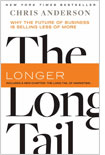
Nearly four years ago, first in a widely cited article and later in a best-selling book, Chris Anderson posited that the Internet, with its vast inventories of books, albums, and movies, would liberate the world from blockbuster schlock. Anderson, the editor of Wired, labeled his concept "the Long Tail," after the shape our digital desires leave on a graph: When we buy stuff online, we can reach beyond big hits and into the "tail" of the demand curve, where we're free to indulge our most obscure passions. Anderson argued that serving our niche interests could also make for booming Web businesses. This was the thrill of the Long Tail—it seemed to offer a way for art and commerce to thrive side-by-side.

Now, just in time for The Long Tail's paperback release, the book has fallen under critical scrutiny. Anita Elberse, a marketing professor at the Harvard Business School, recently examined several years' worth of American movie- and music-sales data. The entertainment business has indeed seen its inventory shifting toward a Long Tail curve, Elberse writes in the Harvard Business Review. The shift is slight, however, and Anderson's Long Tail is also "extremely flat."

Full article here:

Friday, November 9, 2007

MarketingApple - How products are trained to think about people


Marketing Apple - designing products for marketing success -
Steve Chazin is apparently a former Apple marketing Executive and has published an free ebook called Marketing Apple: 5 marketing secrets. If you are an Applesumer and want to know a little more about yourself and your product or rather how products are trained to think about people click here

5 Secrets of the world's best marketing machine?


TrackBack

Thursday, October 4, 2007

Emerging MEdia's impact on the Customer Experience


Emerging Media's Impact on the Customer Experience


From: darmano, 6 months ago


Short summaries of:

* Dell becoming Web 2'd
* USA Today becoming Web 2'd
* Why You Tube isn't just videos (my favourite)
* Good vs ordinary blogging


SlideShare Link

Wednesday, August 22, 2007

Seriously Cool


Seriously Cool
Marketing and communicating with diverse generations
from mccrindle research

... The 21st Century consumer has more products of higher quality across more categories than any consumer in history. In spite of this – or probably because of it, they seek redefined community, regained power, and rediscovered meaning ...


Contents
A. Laying the groundwork – an introduction 4
B. Surveying the social terrain 5
C. Defining the generations 7
D. Marketing in the 21st Century 10
E. Generational segmentation 12
F. Generational marketing 18
G. What we buy and why 22
H. The top five drivers of 21st Century consumers 25
I. Communication styles – bridging the generation gaps 29
J. Engaging with the ever-changing consumer 33
K. Marketing messages – what works best today 37
L. A final word 41
M. Endnotes 42
N. About the authors 44
O About this publication 45
P. More resources 45
Q. Notes 46


more ... >>>

Friday, August 17, 2007

Buy equals ... ?


Image from a presentation on www.iasummit.org

You can view the whole thing here, though this slide says it all.

Wednesday, August 8, 2007

Scandals put paid to made-in-China multinationals?


By Joseph Chaney - Analysis

HONG KONG (Reuters) - Tainted pet food, toxic toothpaste, unsafe tires and toys -- the list goes on.

Scandals involving Chinese products in recent months have caused the "made in China" label to mean defective, dangerous, and -- in the case of poisoned cough syrup in Panama -- deadly.

Fret not, experts say, brands such as PC maker Lenovo Group Ltd.(0992.HK: Quote, Profile, Research) or Brilliance China Automotive Holdings (1114.HK: Quote, Profile, Research) (CBA.N: Quote, Profile, Research) could still capture global market share and become multinationals like Japan's Sony Corp. (6758.T: Quote, Profile, Research) or South Korea's Hyundai Motor Co. (005380.KS: Quote, Profile, Research).

However, that process could take years.

For now, image problems will force savvy players to shape up for a global marketplace and weed out weaker firms, while the massive domestic markets of the world's fourth-largest economy cushion short-term pain.

"In terms of their own management and operating policies, they will be raised to a much more international standard," said Jonathan Chajet, Asia-Pacific strategy director for Interbrand.

"It's how much (they) play 'this is from China' in the branding. That's the part that will probably be set back a little bit." ... more >>

Tuesday, August 7, 2007

GOD - the concept


http://www.goodsofdesire.com/

The Concept
With the rise of Asia as a significant economic force, the world will also show increasing interest in Asian lifestyle and culture. G.O.D. intends to capitalize on this phenomenon by providing an eastern derived lifestyle concept, as an alternative to the established Western way of living. By exploring age-old Oriental traditions and up dating them with modern consumers in mind, G.O.D. wants to demonstrate that the techniques and wisdom of past generations in the east still has a place in the future world.

-------------------------------------------------------------------------------------

The Name
G.O.D. is the phonetic sound of the Cantonese slang "to live better", because to live better is a basic human desire in Hong Kong, Asia and the world.

-------------------------------------------------------------------------------------

Company Mission
To Define a New Asian Identity Asia's climate, diet, space and culture are different from the west, why shouldn't Asians live differently? The exciting challenge for today's Asian designers is to define a new identity for their community.

Preschoolers prefer tucker dished up McDonald's style


Article appeared on theage.com.au
By Jill Stark
August 7, 2007 - 6:00AM

Junk-food advertising's influence on young children has been confirmed by research revealing vegetables taste better to preschoolers if served in McDonald's wrappers.

In a study prompting renewed calls for restrictions on fast-food marketing, four out of five children preferred hamburgers, chicken nuggets, fries, milk and even baby carrots served in McDonald's packaging, over identical food in plain wrappers.

Childhood obesity experts said the results of 300 individual tasting comparisons, with 63 children aged three to five, were alarming.

Seventy-seven per cent preferred fries served on a wrapper with the golden arches logo, compared with 13 per cent who liked them better in plain packaging.

Chicken nuggets in a bag branded with the logo were favoured by 59 per cent while more than half (54 per cent) thought baby carrots in a branded french fries bag tasted better than in a plain bag.

Forty-eight per cent liked the hamburger with the fast food company's logo compared with 37 per cent who preferred it in a plain wrapper. Even milk tasted better, with 61 per cent preferring it in a McDonald's cup.

The study found that the more televisions there were in a preschooler's home, the more likely they were to prefer foods and drinks from McDonald's.

The results from the Stanford University (California) research, published today in the Journal of the American Medical Association, come a week after federal Labor's health spokeswoman, Nicola Roxon, revealed a Kevin Rudd government would ban the use of licensed characters such as Shrek to market junk food to children.

Obesity Policy Coalition spokesman Craig Sinclair said the study strengthened the need for restrictions. "It's a real concern when kids at such a young age are creating a perception in their own minds based on advertising," he said.

McDonald's spokeswoman Christine Mullen said they used Shrek to advertise their Pasta Zoo Happy Meal, which has less fat and more calcium and protein than other options.

Thursday, August 2, 2007

Search site cashes in on eco-guilt


Taken from smh.com.au
By Asher Moses
August 1, 2007


The Sydney-based makers of a so-called eco-friendly version of Google claim they're helping to rescue the planet, but all that's really been saved is the piles of money they're banking in the process.

Hundreds of thousands of searches a day are conducted by Blackle.com users, who use the search engine instead of Google because they believe they're doing their bit for the environment.

Its creator, Toby Heap, said Blackle.com - a custom version of Google with a black rather than a white background - could save thousands of watts of power a year because it took less juice for a monitor to display black than white.

But that claim is now being disputed by those who have tested the theory and say the power saving benefits are negligible or non-existent.

Far from an altruistic venture, the site, like Google itself, makes money from sponsored links that run next to search results.

Heap would not give exact traffic figures or say how much he was making in ad revenue, but he said the site had grown "exponentially" and was now servicing "hundreds of thousands of searches a day".

The site's growth since its launch in February this year is illustrated by a graph on the traffic monitoring website Alexa.

An industry source familiar with search engine marketing estimated Blackle, given such high traffic figures, earned thousands of US dollars in Google Adsense revenue per day.

"It [revenue] is definitely growing and I think if it keeps growing the way it's growing then I think it will become quite a healthy profit, so I hope that's what's going to happen," Heap said.

One of the technology enthusiasts to test whether or not the site's claims had any scientific grounding was Darren Yates, an Australian technology journalist who reviews computer hardware for computer magazines.

He found only tube-based CRT monitors, which have been phased out in favour of newer LCD-based models in most countries, showed any real difference in power consumption between Blackle and Google.

But even with a CRT monitor the drop in power consumption when searching through Blackle was a meagre 7 watts... more >>

Tuesday, July 31, 2007

Re-packaging McDonald's - Australia


From: http://www.theonecentre.com

The One Centre's CEO, John Ford, says, "McDonald's packaging is in millions of Australian hands every day, and seeing this as a highly targeted media vehicle, not just a functional thing, unlocked the door to tell its quality Australian food story at the right time, in the right place, with the right people, in a new way.

"We're excited to be working with McDonald's to transform perceptions of the brand with some amazing truths, told through innovative new branding media, found all around them, but seen through new eyes." more ...

Monday, July 30, 2007

... is the success you will experience when ...


THE Whetstone Edge is the success you will experience when you
gain the insights, strategies,and methodologies to create a
win-win-win business relationships. In win-win-win business
relationships, the main participants shift from being adversial
to co-operative and even collaborative. Everyone wins.

Customers will get more than a product or service. They'll get the emotional fulfillment they desire. When this happens, they eagerly and willingly commit to long-term relationships.

Employees become engaged, they build psychological equity, which enables them to make essential, positive contributions to the customer experience.

Companies, by delivering a desirable customer experience, will build customer equity -- the wealth-creating potential that lies in their relationships with their customers.

this magic moment

Cooler and Sweeter than Me